
Election Special
Kandidata.dk
Some of you might know that I am in an NGO called Fair & Fornuftig, where we use evidence to suggest proposals for strengthening democracy, Danish values, integration, all that good stuff.
One project my collaborator Ben Schenkel has been working on is Kandidata.dk so let’s take a look at the tool and see some of the insights you can get.
Using the answers given on the candidate tests by those running for national election, you can look up politician’s answers, see the average position on a party basis and also see the variation of opinion within the same party.
I love all this because you get to see freedom of speech in practice and you also get to see which parties are stricter about messaging/have more homogenous opinions within their ranks.
Let’s look at the two types of questions.
First Juicy Questions! These are questions where the average position of each party is arranged all the way from completely agree to completely disagree.

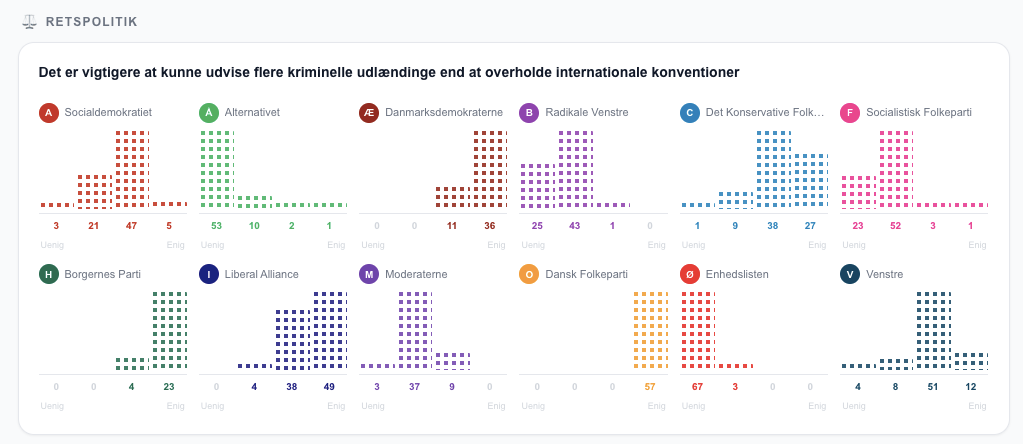
It is more important to be able to expel more criminal foreigners than to comply with international conventions
There is a full spectrum of opinion here where Enhedslisten believe international conventions are the sort of things you do comply with if you have signed up to them all the way across to Dansk Folkeparti who believe strongly that they can dispense with the niceties. But within parties who on average come down in the middle of this issue such as SF, Moderaterne and Socialdemokratiet there is a variation of opinion. The nuances are important and it is healthy that people are reflecting on their own consciences for this matter.
Second, Non-divisive Opinions!
There are some questions which most parties are clustered around the same answer. For example

Sales tax on food should be reduced
Most parties agree that it should be and within the parties there is not much variation in opinion. The only outlier is Liberal Alliance who disagree reasonably vigorously. I guess they like taxes in that party?
The tightest agreement on an issue is

More children with special needs ought to go in special classes rather than ordinary classes
and no party is strongly against that, and very few individual candidates are strongly against that. So if you, the voter, are strongly against, you are shit out of luck because that policy isn’t really on the table.
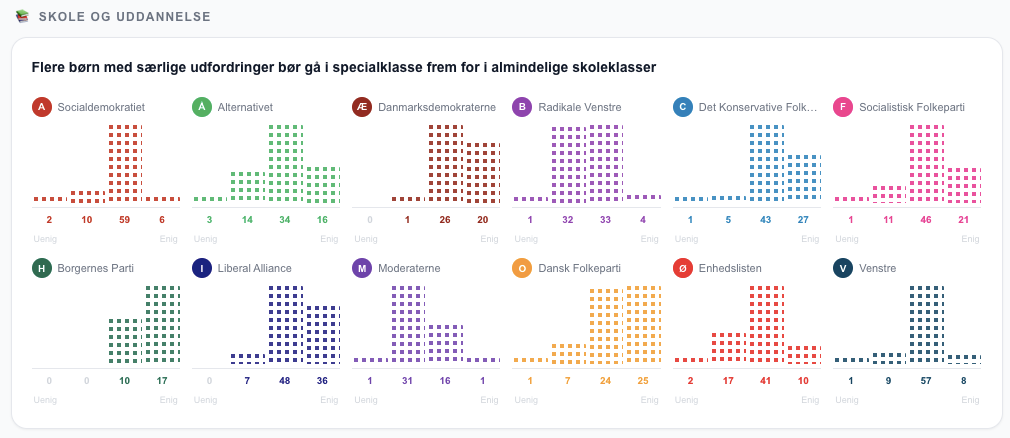
I mean, it’s a bad question which doesn’t help. What kind of special needs? What kind of special classes? What kind of ordinary classes? The nuances are flattened and you find yourself saying that you’re strongly against disabled kids getting the accommodations they need to thrive… or are you saying you are strongly in favour of disabled kids getting the accommodations they need to thrive in ordinary classes? What do any of the answers mean for the disabled kids? It is not clear.
Anyway, have a play around with it, it’s so much fun to dig into the policies and views held by politicians. If you are a nerd or a wonk, this tool is made for you.
If you want to be part of the Fair & Fornuftig project please get in touch, we would love to have you along with us.
LA just loves everything that makes people's lives harder and the richest richer :D