
Mapping Communities
Change has already occurred
I made the most astonishing discovery in the open source databanks the other month. Let me lead you through the sequence of unlikely events that led me there first and you can skip down to the discovery, if you’re not interested, I will never know.
Storytime
I attended an event called Career Journey arranged by International Community in Aarhus. At the event, an attendee asked ‘what is the percentage of internationals in Aarhus?’ and so I offered to look it up1 and then reported back at the end of the talk.
During a coffee break, one of the International Community team approached and said she was sure it was higher than 11% and so we had a chat about why our figures might be different. Could it be she had a workforce percentage? Could one of us have more recent data?
When I went home, I looked up the figure for working age only to get to the bottom of the mystery and found that was 13%… so she was right.
Fresh off of sending a quick message to her about it, I read a piece in Last Week in Denmark about Billund International which quoted the proportion of internationals as 16% and I thought to myself ‘hmm. I wonder what working age proportion is’
It was almost 20%. I nearly fell off my chair.
I got in touch with Simone Giuseppe Uggeri and told him and he suggested I track the development over time. And sure enough, holy Christmas are you kidding me, the number of working age Danish people has been decreasing while the number of working age foreign nationals has been increasing. Before the pandemic, the proportion was close to 5% for years and year, after the pandemic, boom, demographic change.
So, naturally, I looked across the country.
Discovery
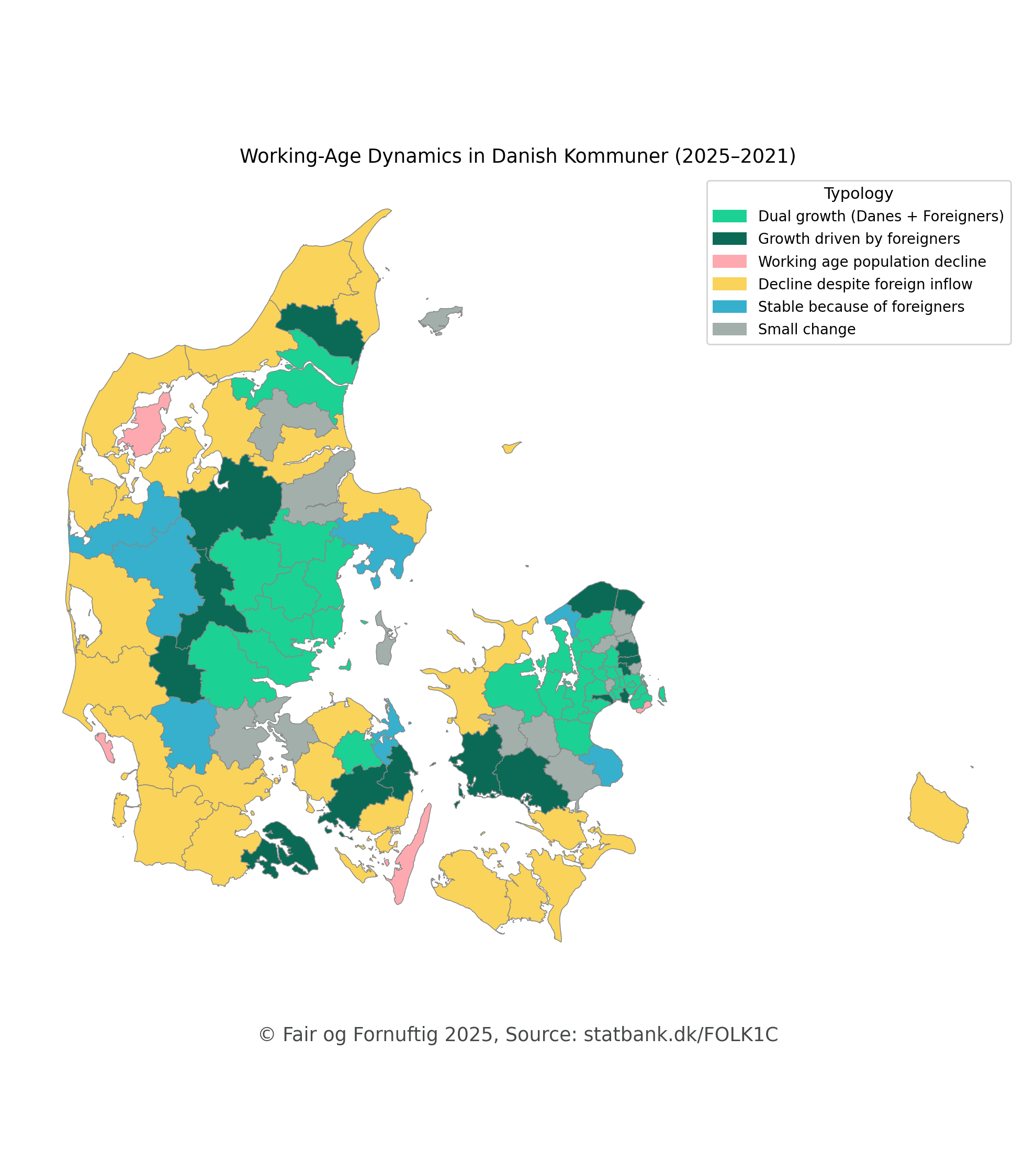
Since the pandemic, the numbers of Danish working age people have been reducing in many kommuner outside the big cities. Two things are happening: one, people are moving to the big cities and two, people are retiring.
If your kommune is one of them, you are properly fudged. Now, you have fewer people paying taxes and an ageing population2, so how are you going to run buses and daycare and schools and care homes? The fact that these kommuner haven’t collapsed entirely is because even while the population of Danish working age people reduces, working age people from abroad have been moving in.
There are some kommuner where the population is still crunching but it would be a lot worse without the Germans, Ukrainians and Romanians et al moving in, and there are some where the total working population is increasing due to immigration.
We talk about immigration as if it were an urban phenomenon but some of the largest proportions of working age foreigners are rural or semi-urban ‘udkantsdanmark’ kommuner.
Why this matters (a lot)
When one in five of residents come from another country, that community is now cosmopolitan and the other four out of five need to adapt to that. It is too late to say ‘no thanks’ to immigration and try to put the genie back in the bottle, if you tell all those guys to eff off back home, you’ll have to close a daycare or reduce a bus timetable.
Another thing that needs to change is the dehumanisation of newcomers. They’re referred to as ‘international arbejdskraft’, like they’re interchangeable economic units. ‘How can we deploy more of these dimser to where they are needed?’, level of discourse. They are actually people. They are people with needs and families and desires. They are all the way human.
Also, the demographics of foreigners is changing slowly but surely. For the time I have been here, ‘foreigner’ has been synonymous with ‘people from the Middle East’ in Danish ‘debate’3. Yes, plenty of people in Denmark have roots in the Middle East but also there are a lot of people making their homes here from other regions in the world.
There’s Germany, obviously, since there are people with German passports from the Danish minority who cross the border to live and work here. But also Germans with no Danish background are coming to work in Denmark, too.
Romania and Poland as well. Within this group, there are temporary workers who complete short term projects such as construction and have no intention of settling permanently (but even so, if a high fraction of your population matches those circumstances, this also has knock-on effects on your community that must be planned for)
And heaps of highly qualified and skilled people from Romania and Poland are working and making their lives medium-to-long-term here, too, it’s never as simple as one story. This development also needs to be handled delicately. What does a family of four from Poland need that a family of four from Denmark doesn’t and vice versa? (Or are their needs the same?)
Danish local politicians haven’t really caught up to their new political reality judging from their answers on the candidate test because they are still talking about the possibility of inviting more foreigners here to work as if the massive sea change in their communities had not already happened.
If they are open to more ‘arbejdskraft’ coming in, it’s with the proviso that they learn Danish. And yes, great. All for that. But how long do they think it takes to get up to intermediate level? How long to native quality fluency? What topics do they think are taught in sprogskoler, what level do they think sprogskoler prepares a student to reach? It’s not ok anymore not to know these things as a local politician dependent on foreign workers. You need to be inside those facts. If you want your new residents to have native quality fluency in Danish within a short time of arriving, you need to figure out how to make that happen and not just cross your fingers.
Change has already happened
What’s crazy about this discovery is that I didn’t make it real by noticing it. There are heaps of communities where this has been true for some time but no one has said it. We have acted as if foreigners are exclusively concentrated in big cities when there has been a much more interesting story hiding this whole time. We didn’t notice it because we were telling ourselves stories based on our assumptions.
Which brings me back to my old faithful hobby horse: data gaps. I found this because the data exist. I was able to search for these facts, clean them up a little and do my data viz thing. There are so many fascinating aspects to life in Denmark that I cannot get close to displaying and explaining because the data aren’t gathered or if they are, they’re not made public.
And to tie a bow on the whole thing. Without those data, without the insights you get from these data, we simply cannot plan for the communities we have.
We need to be a lot more curious.
Hilariously/tragically, my phone autocompleted to the exact table on statbank that I wanted.
Presumably… maybe they move to the big cities too
It’s not technically a debate if everyone agrees