
Unlocking Integration
The MIPEX dataset just dropped
The Migration Policy Group is an independent Brussels-based think-and-do tank. [They] conduct evidence-based projects, research and campaigns in the areas of integration, migration and anti-discrimination.
Mipex 2025 is out! This is a report that scores countries across eight integration policies areas. The report in question is about the EU-27 countries.
To save you from having to look at eight different charts, this is how Denmark did compared to the other EU countries on average.
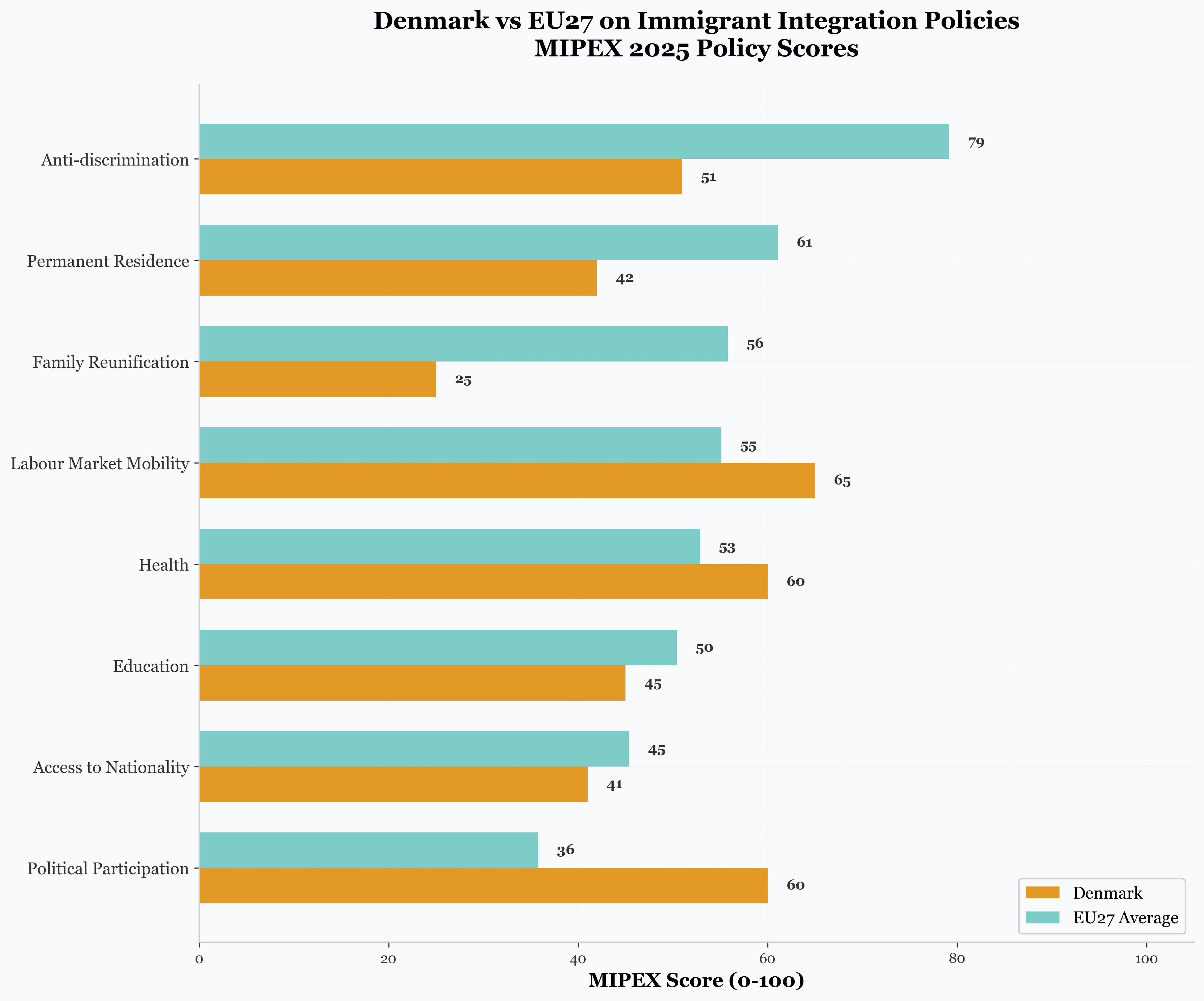
In most of the policies areas, Denmark is ‘less favourable’ than the average EU-27 country. The two areas where the trend is reversed: Health and Political Participation.
Health because so many eastern European countries have unfavourable health care policies that Denmark looks good in comparison and Political Participation because there aren’t that many countries that allow migrants to vote at all. (Denmark allows EU migrants and those who have lived in Denmark for longer than three years to vote in local and regional elections)
But do the enfranchised use those rights? The picture is nuanced.
This is from Kasper Møller Hansen’s ‘Valgdeltagelsen ved kommunal- og regionalvalget 2021’. This chart shows the turnout for EU migrant voters in the 2021 local elections. Danish voters are gold coloured, ‘old EU’ are light teal and the ‘new EU’ are dark teal. We find that northern and ‘old’ EU turnout is lower but closer to Danish turn out. The biggest turn out gap is for southern and ‘new’ EU voters.
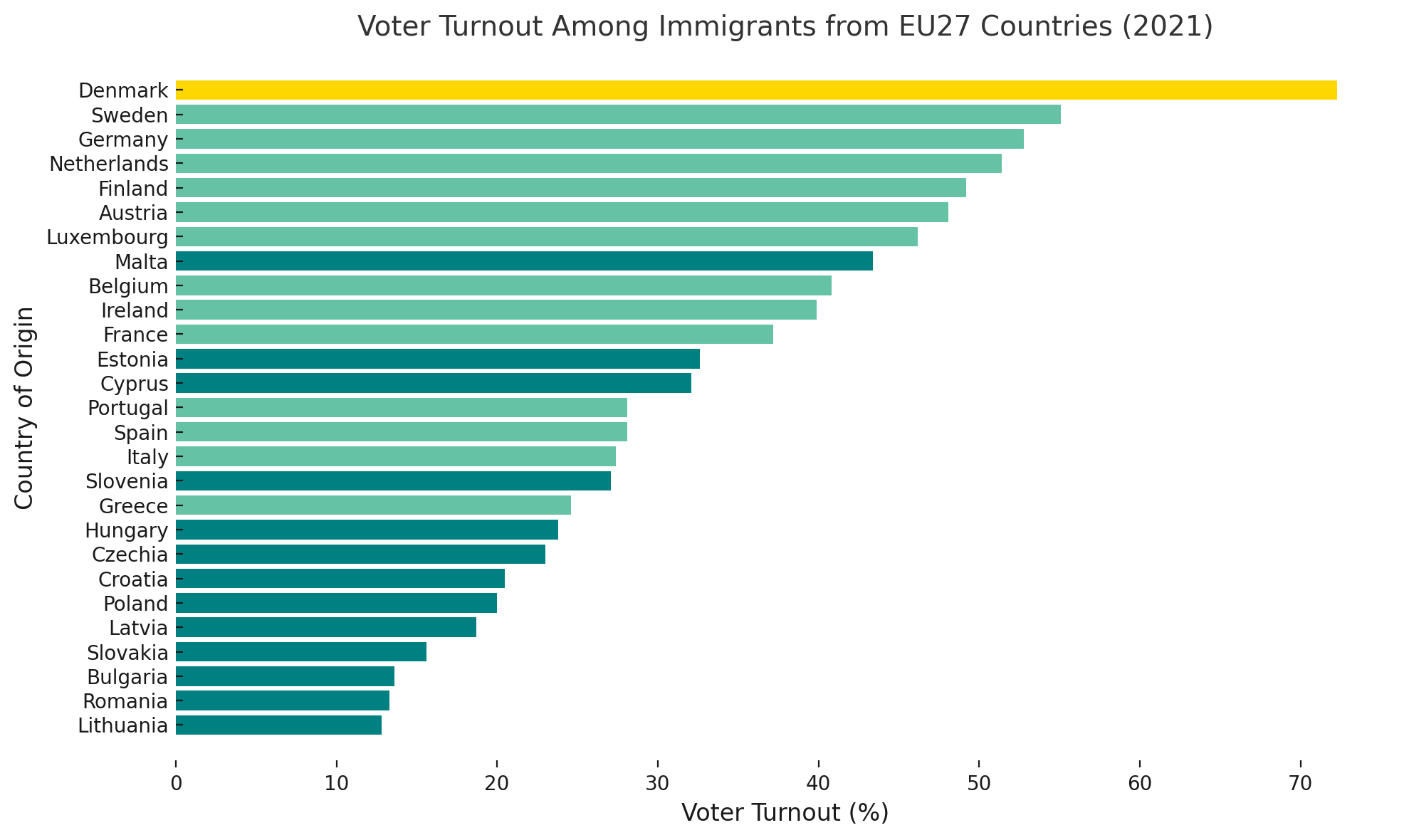
The Mipex report suggests that enfranchising voters does wonders for their integration but maybe it also works the other way around? Denmark’s integration scores are relatively low according to this report, perhaps people who don’t feel included or permanent in a county do not feel like they have a place at the table?
While we are here looking at Kasper Møller Hansen’s report, do you want to see some other pretty interesting charts that I made? Yeah, you do!
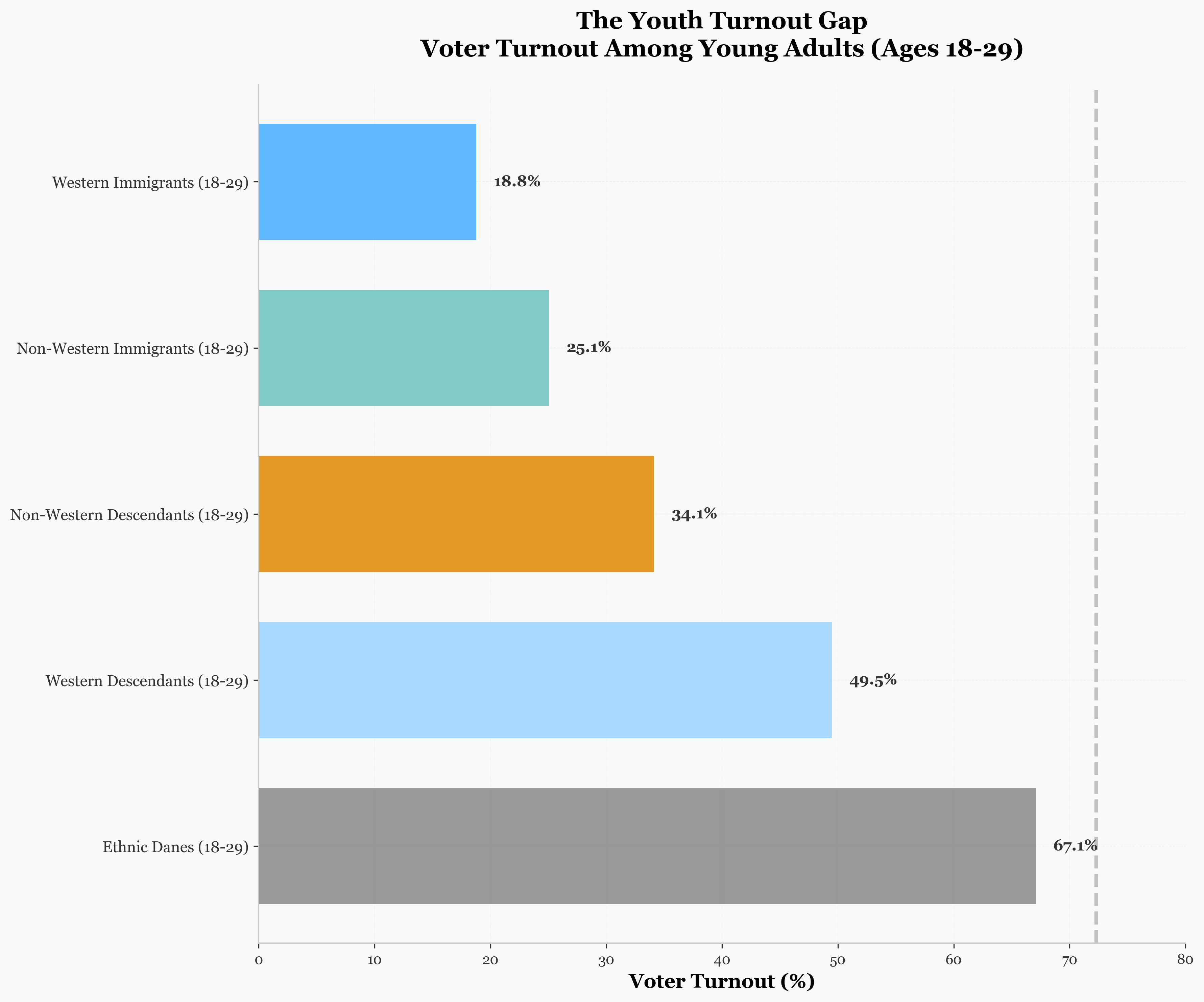
Just looking at the under 30s, the biggest ‘sinners’ for not going to the election booth and doing their democratic duty is western immigrants (so the Lithuanians, Romanians, Bulgarian et al from the table above, presumably?), then non-western immigrants, then non-western ‘descendants’1 , then western ‘descendants’, then Danes.
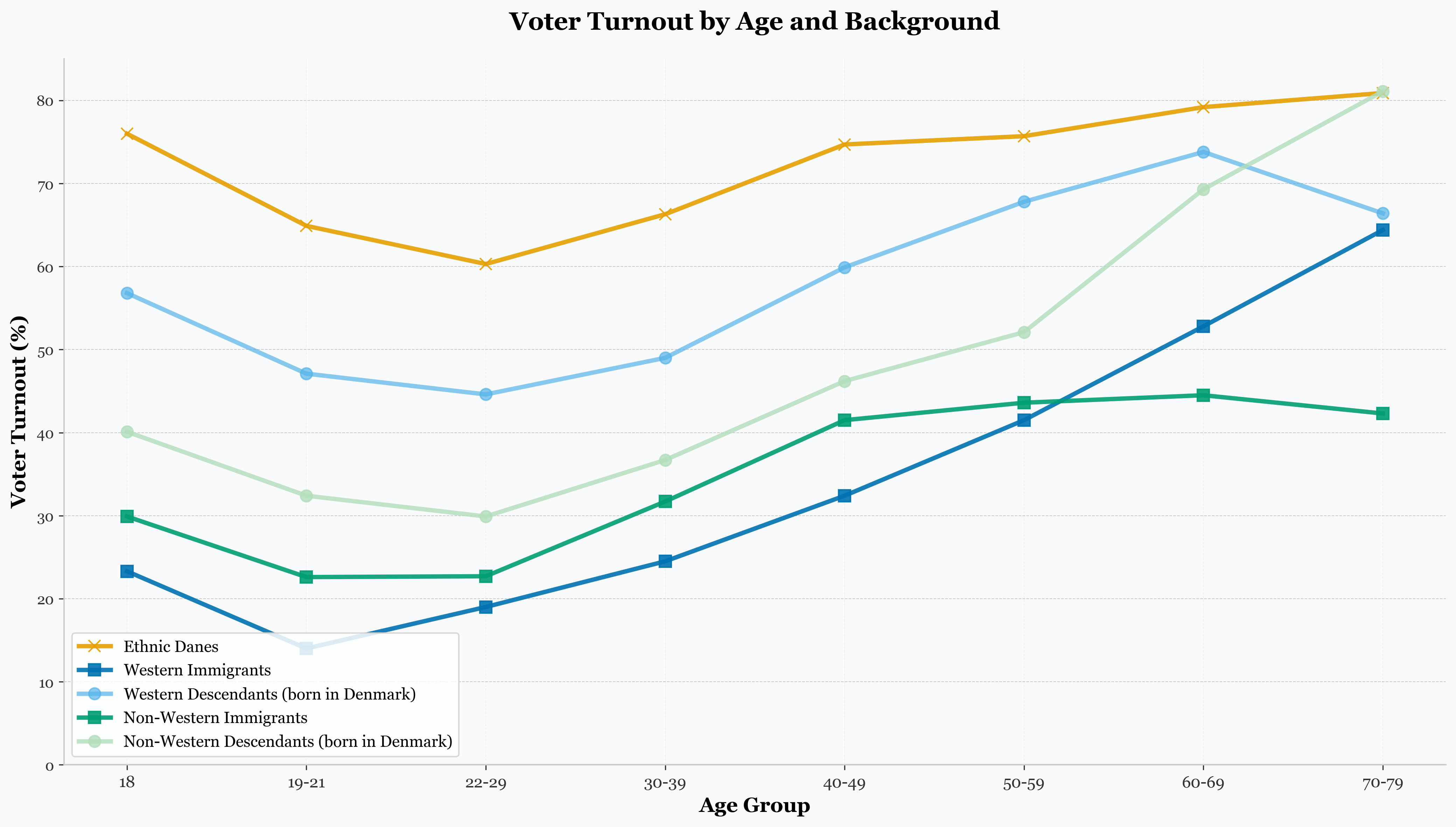
While we’re getting all our nuance out in the open here’s another one. Looking at the different age bands, we can see participation in elections is not as cut and dried as Danes-good-at-voting and Descendants-bad-at-voting. Age and background matter a lot.
You know what, this isn’t academia, let’s go:-
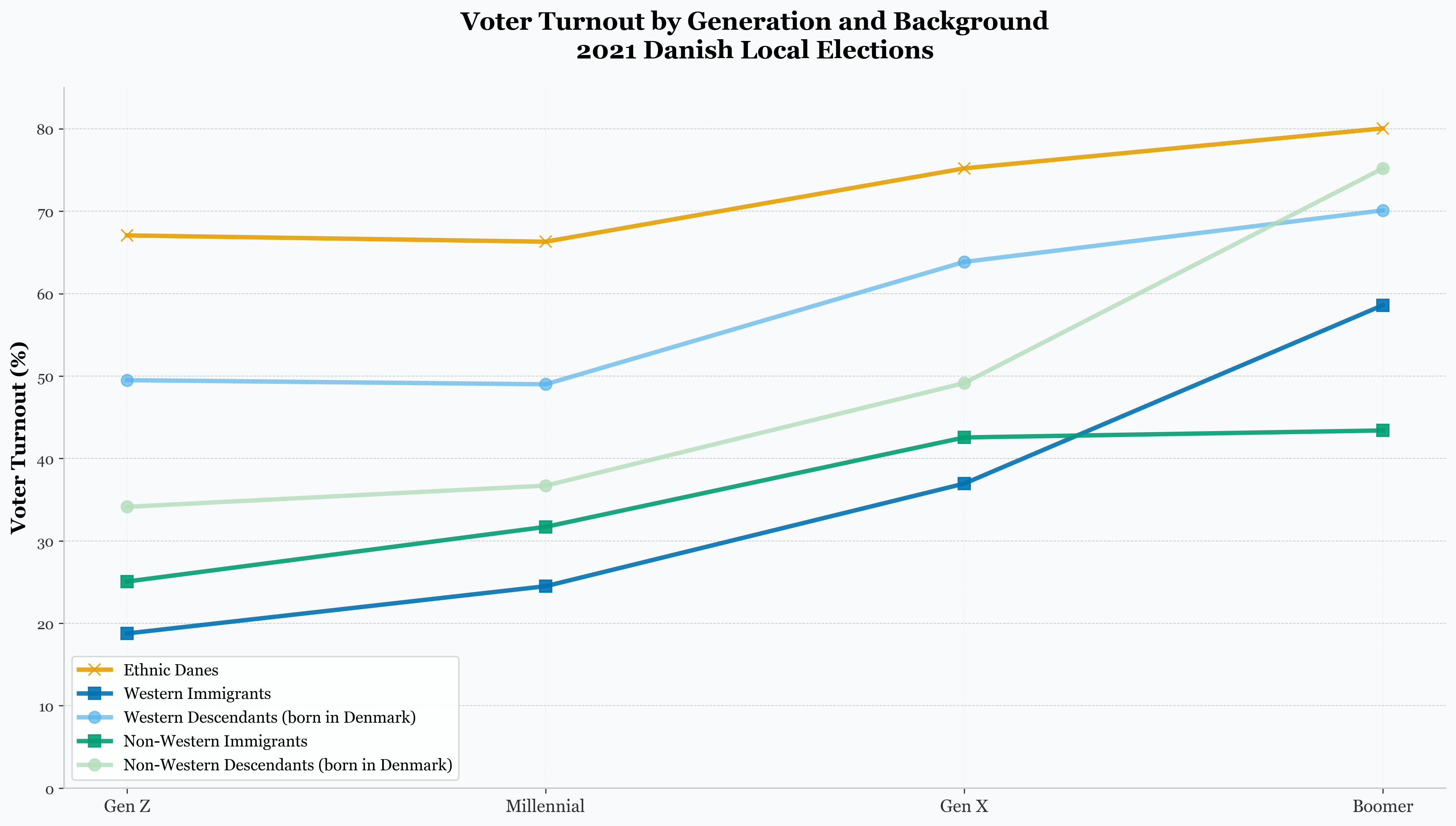
So, as we all suspected and can now see plainly, Zoomers and Millennials suck at democracy. There is no difference in turn out between non-western immigrant Gen X and Boomers. Younger non-western immigrants are better at turning up to vote than western immigrants, and then the situation reverses for Boomer immigrants. We see the mirror image for western and non-western descendants: westerners vote more until the boomer generation, and then the non-westerners vote more. Have to be careful though, there aren’t that many descendants around retirement age in Denmark. It is non-zero but it’s not a lot of people so personality types could be the explanatory factor with a dataset so small.
But for me, the biggest question hiding in all this is why does having foreign parents or grandparents make you less likely to vote than another person who was also born and raised in Denmark? Why does it make a difference? Could it be anything to do with Denmark’s poor ‘education’ integration score according to Mipex?
Also, circling back to one of the earlier graphs, why is voting less likely for ‘new-EU’ migrants? Is it because they skew younger and young people are rubbish at voting in general? Or is it something to do with the histories of their countries of origin? Or the types of jobs they’re doing? If they’re on a contract here for a year or two and then going to work in another country after that, maybe they don’t feel the need to put down democratic roots? Or what is it?
Low participation rates lead to some vicious circles: voters don’t feel represented, so politicians count them out because they don’t vote, so voters don’t feel represented and on and on. I live in a city where 10% of the people who can vote in the upcoming election are foreigners but only two out of the four mayoral candidates could be arsed to be interviewed by the Copenhagen Post2 in English.
Not that foreigners can’t speak Danish, of course, many foreigners can follow the debates just fine in Danish. The thing is though, the ones who aren’t voting are probably in little expat bubbles where they don’t need to be able to say much more than ‘vi betaler hver for sig’ if that.
You might need to meet them where they are, if you want them to come with you. Maybe if they see ‘oh, that party likes small businesses, I’m opening a small business’ or whatever, that might tempt them to learn more Danish so they can learn more about their community. Stranger things have happened. Someone needs to make the first steps. Integration has never meant foreigners coming here and pantomiming Danishnness until it’s time to go back home. Integration involves the host culture making room and valuing newcomers’ perspectives in their communities, too.
I was going to skip week 42 but Mipex was too juicy to wait. Consider this a bonus post, I guess.
This designation refers to people who were born and raised in Denmark but, get this, their parents or grandparents were … foreigners.
An unforced error from the two parties who didn’t take part, in my view. They only got 13.7% and 11.9% last time. Imagine what they could do with 28 988 extra votes. They would trounce the Social Democrats, with that many more votes. A few hundred personal votes could completely destabilise their party list. But they don’t see the point.
Isn’t it surprising that Denmark is the absolute worst in the EU on Anti-discrimination? Especially since it’s always at the top of the rankings on public trust and low corruption.
If this is based on the relevant laws and policies, what are the policies that other countries have that are lacking in DK?
Hi! I’ve got quite confused in this article who you call western immigrants and non-western because in text you list Lithuania, Romania etc. as western countries. Could you please double check your data and your text because, well… it’s rather opposite 😅 also it would do a lot to graphs credibility to see error bars. I know it can make a messy picture, it’s not a scientific journal in the end but also it got me triggered a bit “are they really that dissimilar?!” here and there, so it would seem that it would help. Maybe it’s a touchy subject and graphic cleanliness is less important than data clarity?
Edit: sorry! I forgot human pleasantries! I enjoy your content and thank you for it! My comment is purely from being engaged and invested. No bad intentions whatsoever.